On this post, I will be exploring BGP route summarizations. I will be using the below topology to expand further on this topic.
From the topology, below are some informations to consider:
- R1 and R2 is represented as CE1 and CE2 which is connected to PE1 and PE2, respectively via eBGP
- R1 is connected to SW1 and is running OSPF, while R2 is connected to SW2 and is also running OSPF.
- The SW are advertising the following network address into OSPF:
4. Redistributed the connected prefixes with loopbacks 1,2,3 and 4.
5. Loopback 5 and 6 is learned from another OSPF process ( simulating another network downstream)

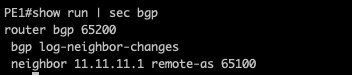
eBGP peering between CE1 and PE1:

iBGP peering between CE1 <–> CE2 and eBGP peering between CE2 and PE2

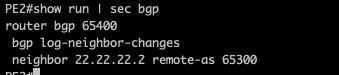


So from the output above, we can confirmed that both CE1 and CE2 are forming the eBGP towards the PE routers and iBGP for both CE’s.
So lets check the OSPF configurations on R1 <–> SW1:



Lets check the OSPF neighbors:


and the prefix learned by CE1 via OSPF:
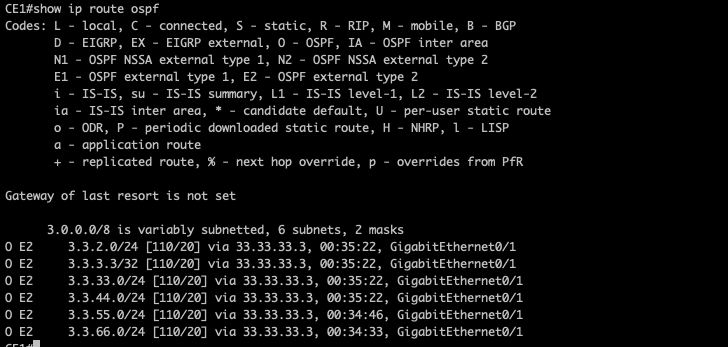
All the prefixes are learned as External OSPF routes by CE1.
Now let me advertise the same prefixes into BGP in CE1.

As observed above CE is advertising the prefixes towards the PE1.
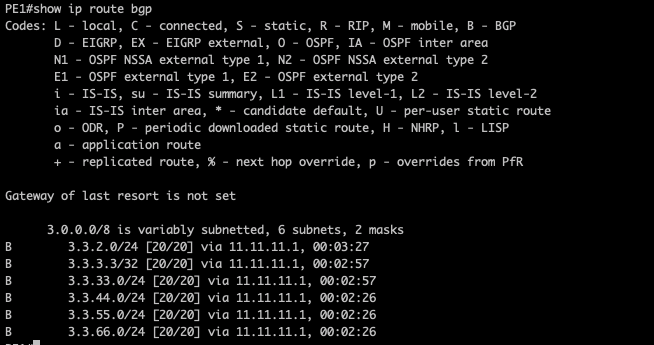
And PE1 is also receiving the same prefixes. Now let me add and aggregate summary for the prefixes on CE1:

And as expected, CE1 is sending a summary route on PE1:
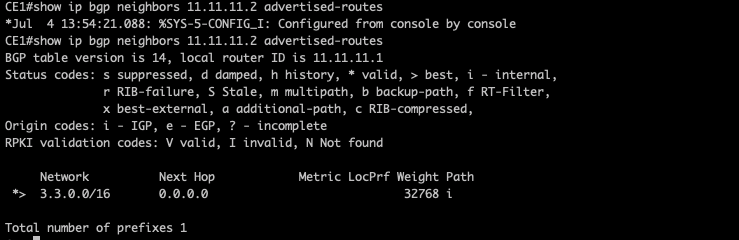

PE1 router is receiving the same summary routes from CE1 with Admin distance of 20(eBGP).
Adding another subnets on SW1 as follows :
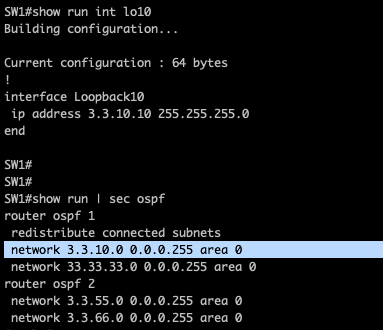
Let me take all the individual prefixed added into BGP and just leaved the aggregate-address,

As observed, the prefixed is no longer available on CE1 routing table,

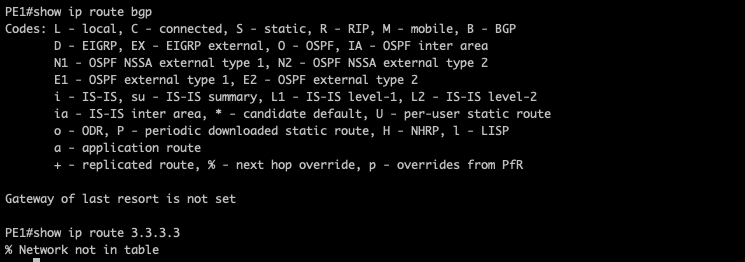
Note: In order to perform route aggregations in BGP, the prefixed must be advertise via network statement,
Now, let me add the same prefixes into BGP again.

As noticed the aggregate routes is added into BGP routing table and is again advertised into the PE router.

Would expect the same aggregate routes on CE2,

 NETWORK LESSON
Leave a comment