On this study notes, I will be going through a concepts called VRF Lite…VRF without MPLS is known as VRF Lite…On my study notes, I will be setting up VRF-A and VRF-B (analogous to customer A and customer B) which is connected just with a Single ISP router…
Here is my topology for this laboratory…
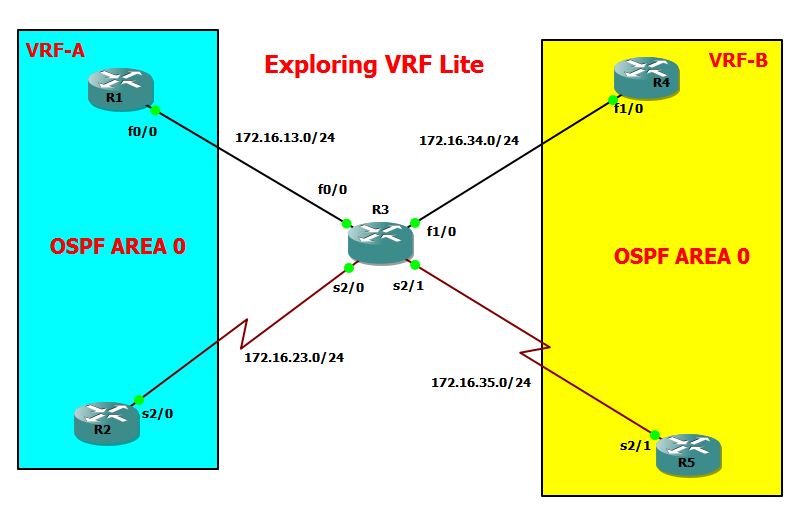
Let’s configure VRF-A:
Below are my approach for the configurations..
1. Enable OSPF on R1 & R2..
2. Create the VRF instance ( VRF-A)
3. Set up VRF forwarding on ISP interface that are connected to VRF-A customers..
4. Configure OSPF in ISP with the VRF command..
Configurations:
R1#sh run | sec ospf
router ospf 1
network 1.1.1.1 0.0.0.0 area 0
network 172.16.13.0 0.0.0.255 area 0
R2#sh run | sec ospf
router ospf 1
network 2.2.2.2 0.0.0.0 area 0
network 172.16.23.0 0.0.0.255 area 0
ISP#sh run | sec ospf
router ospf 1 vrf VRF-A
network 172.16.13.0 0.0.0.255 area 0
network 172.16.23.0 0.0.0.255 area 0
ISP#show ip ospf neighbor
Neighbor ID Pri State Dead Time Address Interface
1.1.1.1 1 FULL/DR 00:00:36 172.16.13.1 FastEthernet0/0
172.16.23.2 0 FULL/ – 00:00:32 172.16.23.2 Serial2/0
Let’s check the OSPF routes on ISP router…
ISP#show ip route vrf VRF-A ospf
Routing Table: VRF-A
Codes: L – local, C – connected, S – static, R – RIP, M – mobile, B – BGP
D – EIGRP, EX – EIGRP external, O – OSPF, IA – OSPF inter area
N1 – OSPF NSSA external type 1, N2 – OSPF NSSA external type 2
E1 – OSPF external type 1, E2 – OSPF external type 2
i – IS-IS, su – IS-IS summary, L1 – IS-IS level-1, L2 – IS-IS level-2
ia – IS-IS inter area, * – candidate default, U – per-user static route
o – ODR, P – periodic downloaded static route, H – NHRP, l – LISP
+ – replicated route, % – next hop override
Gateway of last resort is not set
1.0.0.0/32 is subnetted, 1 subnets
O 1.1.1.1 [110/2] via 172.16.13.1, 00:28:01, FastEthernet0/0
2.0.0.0/32 is subnetted, 1 subnets
O 2.2.2.2 [110/65] via 172.16.23.2, 01:13:52, Serial2/0
ISP#
Let’s check the connectivity from R1 to R2..
R1#ping 2.2.2.2 source 1.1.1.1
Type escape sequence to abort.
Sending 5, 100-byte ICMP Echos to 2.2.2.2, timeout is 2 seconds:
Packet sent with a source address of 1.1.1.1
!!!!!
Success rate is 100 percent (5/5), round-trip min/avg/max = 56/71/84 ms
R1#
We can also do that from the ISP router with the following command:
ISP#ping vrf VRF-A 2.2.2.2
Type escape sequence to abort.
Sending 5, 100-byte ICMP Echos to 2.2.2.2, timeout is 2 seconds:
!!!!!
Success rate is 100 percent (5/5), round-trip min/avg/max = 52/56/60 ms
ISP#ping vrf VRF-A 1.1.1.1
Type escape sequence to abort.
Sending 5, 100-byte ICMP Echos to 1.1.1.1, timeout is 2 seconds:
!!!!!
Success rate is 100 percent (5/5), round-trip min/avg/max = 56/60/72 ms
NOW, let’s configure VRF-B…
R4#sh run | sec ospf
router ospf 1
network 4.4.4.4 0.0.0.0 area 0
network 172.16.34.0 0.0.0.255 area 0
R5#sh run | sec ospf
router ospf 1
network 5.5.5.5 0.0.0.0 area 0
network 172.16.35.0 0.0.0.255 area 0
ISP#sh run | sec ospf
router ospf 2 vrf VRF-B
network 172.16.34.0 0.0.0.255 area 0
network 172.16.35.0 0.0.0.255 area 0
Let’s check the OSPF neighbors:
ISP#show ip ospf neighbor
Neighbor ID Pri State Dead Time Address Interface
5.5.5.5 0 FULL/ – 00:00:39 172.16.35.5 Serial2/1
172.16.34.4 1 FULL/DR 00:00:28 172.16.34.4 FastEthernet1/0
1.1.1.1 1 FULL/DR 00:00:34 172.16.13.1 FastEthernet0/0
172.16.23.2 0 FULL/ – 00:00:29 172.16.23.2 Serial2/0
ISP#
So what does the ISP tells about it’s VRF-B routing table…So ISP have both R4 and R5 loopback address…
ISP#show ip route vrf VRF-B ospf
Routing Table: VRF-B
Codes: L – local, C – connected, S – static, R – RIP, M – mobile, B – BGP
D – EIGRP, EX – EIGRP external, O – OSPF, IA – OSPF inter area
N1 – OSPF NSSA external type 1, N2 – OSPF NSSA external type 2
E1 – OSPF external type 1, E2 – OSPF external type 2
i – IS-IS, su – IS-IS summary, L1 – IS-IS level-1, L2 – IS-IS level-2
ia – IS-IS inter area, * – candidate default, U – per-user static route
o – ODR, P – periodic downloaded static route, H – NHRP, l – LISP
+ – replicated route, % – next hop override
Gateway of last resort is not set
4.0.0.0/32 is subnetted, 1 subnets
O 4.4.4.4 [110/2] via 172.16.34.4, 00:18:04, FastEthernet1/0
5.0.0.0/32 is subnetted, 1 subnets
O 5.5.5.5 [110/65] via 172.16.35.5, 00:17:54, Serial2/1
But as we can see from the results below, the global routing table does not show any OSPF routes..
ISP#show ip route ospf
Codes: L – local, C – connected, S – static, R – RIP, M – mobile, B – BGP
D – EIGRP, EX – EIGRP external, O – OSPF, IA – OSPF inter area
N1 – OSPF NSSA external type 1, N2 – OSPF NSSA external type 2
E1 – OSPF external type 1, E2 – OSPF external type 2
i – IS-IS, su – IS-IS summary, L1 – IS-IS level-1, L2 – IS-IS level-2
ia – IS-IS inter area, * – candidate default, U – per-user static route
o – ODR, P – periodic downloaded static route, H – NHRP, l – LISP
+ – replicated route, % – next hop override
Gateway of last resort is not set
ISP#
Let’s check the connectivity between R4 and R5…
R4#ping 5.5.5.5 source 4.4.4.4
Type escape sequence to abort.
Sending 5, 100-byte ICMP Echos to 5.5.5.5, timeout is 2 seconds:
Packet sent with a source address of 4.4.4.4
!!!!!
Success rate is 100 percent (5/5), round-trip min/avg/max = 60/79/88 ms
R4#
We can also test the connections from ISP router,
ISP#ping vrf VRF-B 4.4.4.4
Type escape sequence to abort.
Sending 5, 100-byte ICMP Echos to 4.4.4.4, timeout is 2 seconds:
!!!!!
Success rate is 100 percent (5/5), round-trip min/avg/max = 52/55/60 ms
ISP#ping vrf VRF-B 5.5.5.5
Type escape sequence to abort.
Sending 5, 100-byte ICMP Echos to 5.5.5.5, timeout is 2 seconds:
!!!!!
Success rate is 100 percent (5/5), round-trip min/avg/max = 52/56/60 ms
ISP#
***************************END OF LAB***********************************
 NETWORK LESSON
Leave a comment